
Overview bilateral approach
Switzerland is located in the heart of Europe and is surrounded almost entirely by member states of the EU. In view of its geographic and cultural proximity and particularly due to its political and economic importance, the EU with its 27 member states is by far Switzerland’s most important partner. In view of its close and wide-ranging ties with the EU, Switzerland has adopted an approach based on an array of bilateral agreements in clearly defined areas: the bilateral approach.
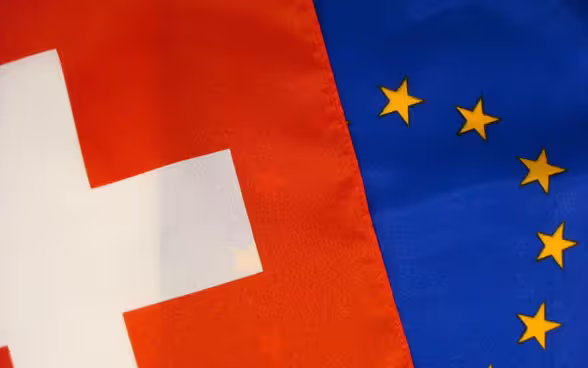
However, Switzerland is also a first-rate partner for the EU. A concerted and targeted policy of interests towards the EU is therefore of crucial importance for Switzerland's prosperity.
Switzerland's European policy goal is to create the best possible conditions for its relations with the EU. Since Switzerland is not an EU member state, it pursues its European policy on the basis of bilateral sectoral agreements. With this in mind, the bilateral treaty framework between Switzerland and the EU (or its predecessors) has been continuously developed and deepened over the decades.
Since the Free Trade Agreement of 1972, an increasingly dense network of around 20 main agreements and a large number of other treaties has been established in several stages. The people have confirmed and supported the so-called bilateral approach in various referenda. The strengthening and further development of the bilateral approach, which also includes the possible conclusion of new market access agreements with the EU, is of central importance for Switzerland.
The step-by-step, pragmatic approach allows for tailor-made, contractual solutions for a broad range of economic and political issues. On the one hand, the agreements create extensive mutual market access. On the other hand, they are the basis for close cooperation in important political areas. The bilateral approach thus enables a policy of openness and close cooperation with European neighbours.
Chronology
Documents
For more on this see
Legal Aspects
Legal collection of all EU decrees that are relevant for Switzerland and overview of the legal protection that citizens and companies can invoke.
Economic importance of the bilateral agreements
The bilateral approach has proved successful – thanks to sectoral agreements, Switzerland's access to the single market gives it an economic advantage.
Mixed Committee
The Joint Committees manage the implementation of the bilateral agreements. They are composed of representatives of Switzerland and the EU.
Entry into force
Entry into force of the main Bilateral Agreements Switzerland-EU since 1972.
Institutional agreement (up to 2021)
A Swiss–EU institutional agreement has not been signed. The bilateral talks did not produce the results Switzerland needed to sign the agreement.
Popular votes and chronology
Important stages of Swiss European policy as well as votes on European policy issues since the rejection of accession to the EEA in 1992.
Contact
State Secretariat STS-FDFA
Federal Palace East
3003 Bern