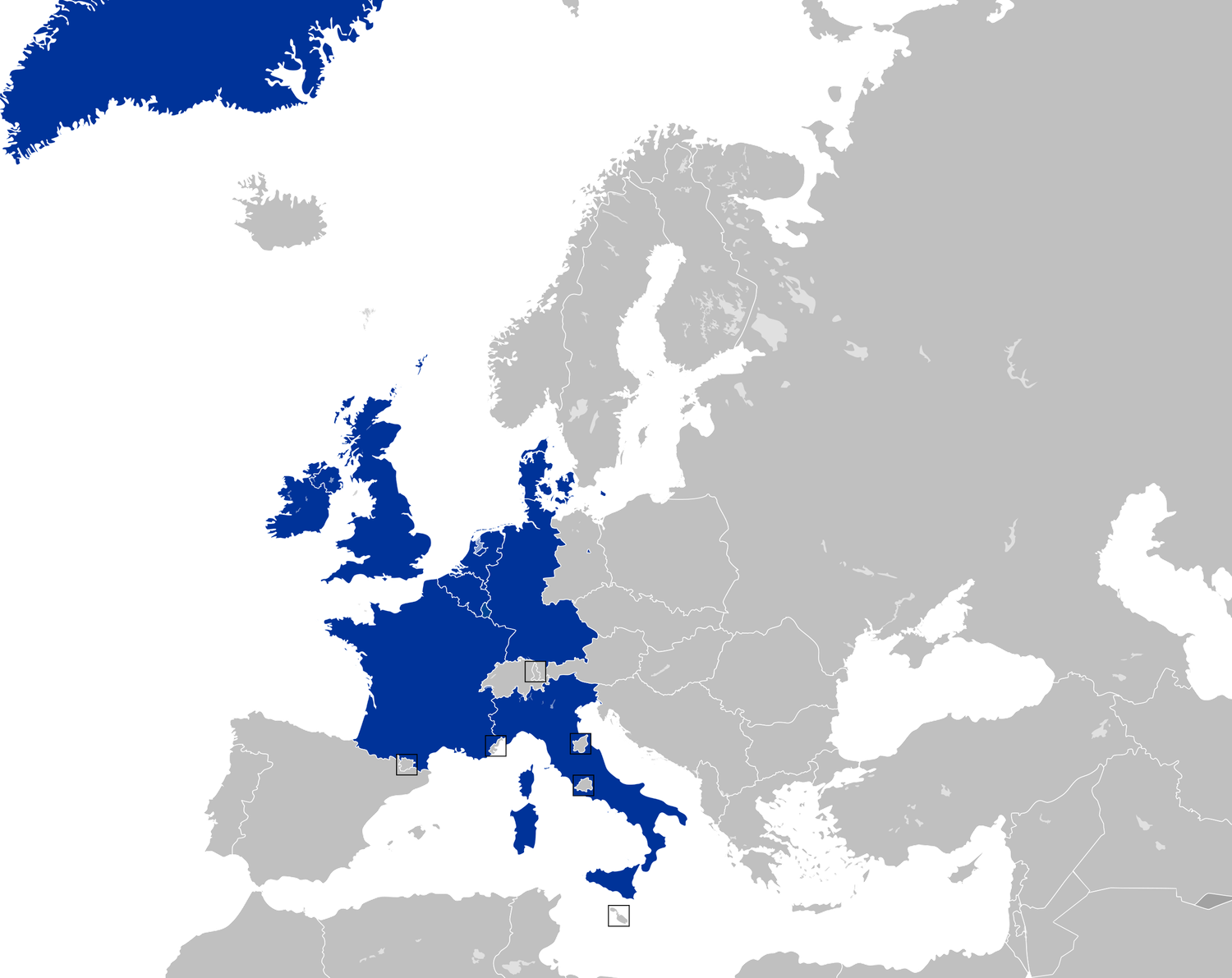
The European Communities (EC) comprised the European Coal and Steel Community (ECSC), the European Economic Community (EEC) and the European Atomic Energy Community (Euratom). These three organisations merged in 1967. Successive waves of enlargement from 1973 resulted in 12 member states by 1985. In signing the Single European Act in 1986, these countries expressed their intention to establish the European Union (EU).
The EU emerged from the idea of ensuring peace in Europe after the Second World War and preventing future military conflicts. This was to be achieved by concerted economic integration and intensified cooperation that would stimulate growth in a larger market. Belgium, the Federal Republic of Germany, France, Italy, Luxembourg and the Netherlands signed the Treaty of Paris in 1951, establishing the European Coal and Steel Community (ECSC).
Treaties of Rome
The institutions of the ECSC laid the foundations of the EU. In the course of time, the ECSC High Authority, its executive body, became the European Commission, and the Common Assembly became the European Parliament.
The next step was taken with the signing of the Treaties of Rome in 1957, which established the European Economic Community (EEC) and the European Atomic Energy Community (Euratom). With this, the six countries envisaged the creation of a free, common market and the development of nuclear power for peaceful purposes. The third step was the Merger Treaty. This fused the institutions of the three communities in 1967, which were then redesignated as bodies of the European Communities.
Enlargements from six to twelve member states
In 1973 Denmark, Ireland and the United Kingdom joined the European Communities in the first wave of enlargement (the 'northern enlargement'). The United Kingdom had previously applied to join in 1963 but its membership was vetoed at the time by France. On joining the EC, the United Kingdom withdrew from the European Free Trade Association (EFTA), which it had co-founded as a counterbalance to the EC.
Through further enlargement, Greece became the tenth member state in 1981. Portugal and Spain joined in 1985, following the almost unanimous approval of both countries' national parliaments. Portugal withdrew from EFTA, a move which further weakened the free trade area. Spain's accession to the EC enabled it to emerge from the isolation it had experienced during the Franco dictatorship. Although some member states had feared a wave of migration from these two countries, this did not materialise.
The Single European Act
The signing of the Single European Act in 1986 marked the conclusion of a process of reform lasting several years. The Treaties of Rome were revised and expanded. The Act envisaged the completion of the European Single Market by 1993, harmonisation of economic legislation and the removal of all national barriers to trade in the EU zone. The Single European Act was the first major reform of the founding treaties of the European Communities. It was conceived as a first step towards a European Union, forming a contractual basis for European political cooperation. This cooperation has been extended to cover more areas, and measures have been adopted to strengthen internal cohesion, improve the ability to take decisions and make the decision-making process more democratic.
Milestones
In September 1946, Churchill – British prime minister from May 1940 to July 1945 – called for Europe to unite along the lines of the United States. The «United States of Europe» would enable the European family to live in peace and security, Churchill said in a speech at the University of Zurich.
On 9 May 1950, French Foreign Minister Robert Schuman proposed the idea of common control over the production of coal and steel together with the Federal Republic of Germany and possibly other European countries. This idea is regarded as the foundation stone of today's European Union. Since 1986, Europe Day has been celebrated every year on 9 May.
On 18 April 1951, Belgium, the Federal Republic of Germany, France, Italy, Luxembourg and the Netherlands signed the Treaty of Paris establishing the European Coal and Steel Community (ECSC). The aim was to create a common market among equal partners after the end of the Second World War.
At a conference in Messina at the start of June 1955, the foreign ministers of the six ECSC member states agreed to widen the process from coal and steel to encompass further economic integration.
On 25 March 1957 the six member states party to the Treaty of Paris signed the treaties establishing a European Economic Community (EEC) and a European Atomic Energy Community (Euratom) in Rome. These treaties came into force on 1 January 1958. The EEC envisaged a common internal market and a customs union with free movement of persons, goods, services and capital. Euratom was intended as an instrument to control and coordinate civilian nuclear power.
At the initiative of the United Kingdom, the seven non-EEC states of Austria, Denmark, Norway, Portugal, Sweden, Switzerland and the United Kingdom signed the Convention establishing the European Free Trade Association (EFTA) in Stockholm on 4 January 1960. This was intended as a counterbalance to the EEC and Euratom.
The executive bodies of the three communities, ECSC, EEC and Euratom, were merged in a treaty signed on 4 April 1965. They were replaced by a single Council of Ministers and a Commission. The Merger Treaty came into effect on 1 July 1967.
After a political crisis lasting almost a year, France agreed to resume participation in Council meetings. In return, the Council was to continue to require unanimity in decisions where major interests were at stake.
Denmark, Ireland and the UK joined the European Communities and simultaneously left EFTA. Norway rejected accession in a referendum.
The member states signed a treaty that gave the European Parliament wider budgetary powers and enabled the establishment of the European Court of Auditors. The treaty entered into force on 1 June 1977.
For the first time, citizens of the member states elected their representatives to the European Parliament in direct elections in June 1979. Ever since, elections have taken place every five years.
Greece became the tenth country to join the European Communities.
On 14 June 1985 Belgium, France, Germany, Luxembourg and the Netherlands signed the Schengen Agreement, which provided for the progressive reduction of checks on individuals at the internal borders of the contracting parties. The agreement was incorporated into the EU Treaty of Amsterdam of 1999.
Portugal – which left EFTA – and Spain joined the European Communities, raising the number of member states to 12.
The Single European Act was signed in February 1986. It set the goal of completing the European single market with free movement of persons, goods, services and capital without any border controls by 1993. It also strengthened the European Parliament's co-decision rights and extended the areas in which Council decisions were to be taken by a qualified majority vote. The Single European Act came into force on 1 July 1987.