Content of the package Switzerland-EU (Bilaterals III)
The relations between Switzerland and the European Union (EU) have developed over the past two decades to the benefit of both sides, thanks to the Bilaterals I (1999) and II (2004). The bilateral approach, embarked upon after Switzerland’s refusal to join the EEA in 1992, has shown itself to be robust and capable of achieving majority support. Therefore, the Federal Council wants to stabilise and further develop it with the package Switzerland-EU.
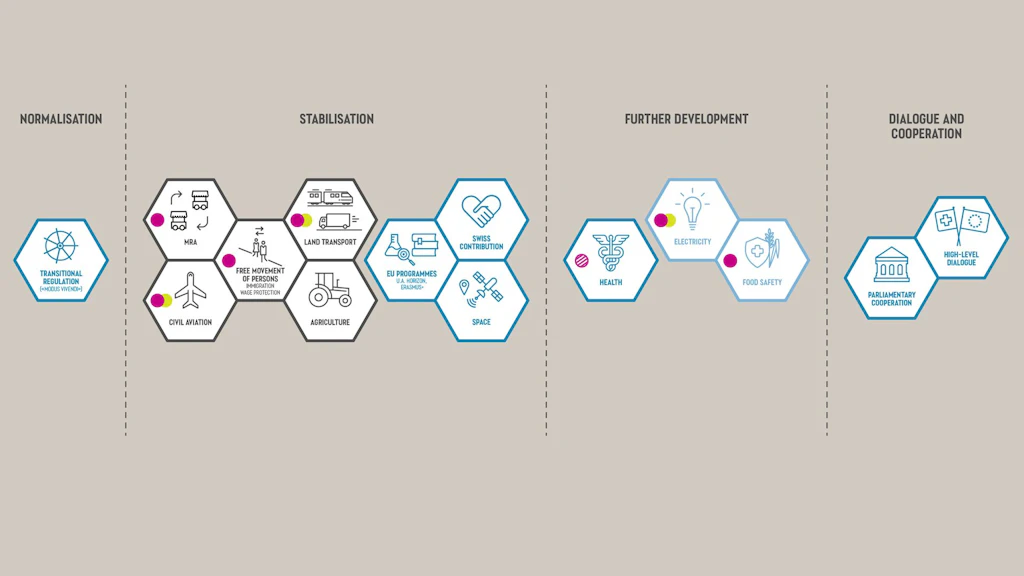
The Federal Council continues to consider the bilateral approach the best option for shaping Switzerland's relations with the EU. This path has been developed gradually and pragmatically over the past 25 years and has contributed significantly to Switzerland's economic and scientific success. The package Switzerland-EU builds on this and supplements the existing agreements in the areas of air transport, land transport, free movement of persons, MRA and agriculture with new agreements in the areas of electricity, health and food safety. By consolidating its sectoral participation in the EU single market, Switzerland is creating reliable framework conditions for its export-led economy and is thus strengthening its prosperity. The package also ensures participation in key research programmes such as Horizon Europe and thus strengthens Switzerland as a location for innovation.
The package contains the following elements:
a) Stabilisation b) Further development c) Dialogues and cooperation d) Transitional provisions
a) Stabilisation
Internal market agreements
Switzerland participates in certain areas of the EU internal market. This is currently regulated in five agreements covering the free movement of persons, land transport, air transport, agriculture and mutual recognition in relation to conformity assessments (MRA) respectively. As part of the further development of the bilateral approach, an agreement on electricity should be added and the existing agriculture agreement should be expanded to cover food safety (in a separate protocol).
Switzerland and the EU concluded the Agreement on the Free Movement of Persons (AFMP) in 1999 (Bilaterals I). The AFMP is to be updated as part of the stabilisation of the bilateral approach. The AFMP allows EU nationals and their family members to live, work and study in Switzerland under certain conditions; the same conditions apply to Swiss nationals in the EU member states. The focus here is on inward and outward migration for the purpose of working. The Agreement on the Free Movement of Persons (AFMP) concluded between Switzerland and the EU in 1999 not only regulates immigration for the purpose of working, but also the cross-border provision of services by posted employees and self-employed workers. The negotiations with the EU on wage protection related to this area of the AFMP, which applies to workers who come to Switzerland from an EU member state to work for a certain period of time, either at the request of their employer or in a self-employed capacity. Under this reciprocal arrangement, employees and self-employed persons from Switzerland can also carry out work assignments in an EU member state.
Immigration
In 2004, the EU issued Directive 2004/38/EC (known as the EU Citizens' Rights Directive). This directive regulates the right of EU nationals to move and reside freely within the territory of the member states. However, it does not grant any political rights, in particular the right to vote or stand for election.
The AFMP is to be updated as part of the stabilisation of the bilateral approach. With regard to the free movement of persons to and from the EU, Switzerland will adopt part of Directive 2004/38/EC. Migration under the AFMP remains focused on persons who are seeking employment. This form of migration strengthens the Swiss economy by providing the required skilled labour, while at the same time protecting the Swiss social security system. Furthermore, the provisions of the Swiss Federal Constitution will be respected in relation to the rules on judicial expulsion under criminal law. In addition, the notification procedure for work-related short stays will be retained.
The newly designed safeguard clause provides the Swiss protective mechanism with an additional instrument in the event that immigration leads to serious economic or social problems.
Wage protection
Swiss and foreign companies should have the same competitive conditions; cross-border provision of services must not lead to the unfair undercutting of Swiss wages and conditions of employment. This is why the accompanying measures set out in the Posted Workers Act (PWA) were introduced in Switzerland in 2004. The PWA includes provisions on:
the notification procedure for posted workers;
the wages and working conditions of posted workers;
monitoring compliance;
sanctions in the event of a breach of the conditions;
measures to combat false self-employment.
The conditions for posting workers are also regulated within the EU. With the stabilisation and further development of bilateral relations within the framework of the Switzerland–EU package (Bilaterals III), Switzerland will in principle adopt the EU's rules on the posting of workers.
In the negotiations with the EU, Switzerland agreed on a multi-level system of safeguards in order to protect wage levels. However, certain concessions to the EU were unavoidable. The Federal Council, cantons, employers and unions therefore agreed on additional domestic policy measures. Taken together, the negotiated agreement, the implementing legislation and the accompanying domestic measures mean that the level of wage protection will be maintained.
The inclusion of the new institutional elements in the MRA ensures that the agreement will be regularly adapted to the relevant developments in EU law in the future. The MRA's status as an equivalence agreement remains unchanged. In addition, Switzerland will be able to participate in EU market surveillance, consisting of measures to ensure product safety and quality. Switzerland and the EU have set out the arrangements for their cooperation from the end of 2024 until the package comes into force. They will work closely together within this framework to ensure the proper functioning of the existing internal market agreements. In particular, they will discuss how to implement the MRA, bearing in mind the needs of economic stakeholders.
The 1999 Agricultural Agreement is now divided into two parts: one on agriculture, which is not subject to the dynamic adoption of EU legislation, and one on food safety (see bellow), which is now regulated by a specific protocol and is subject to dynamic adoption. Swiss and EU agricultural policies will not be harmonised; existing Swiss border protection for agricultural products remains unchanged.
The amendments to the Air Transport Agreement enable the exchange of cabotage rights (8th and 9th freedom) that Switzerland has long sought. This means that Swiss airlines can offer flights within an EU Member State, and EU airlines can offer domestic flights in Switzerland.
In addition, the institutional rules and regulations on state aid in the Air Transport Agreement were updated in accordance with the new institutional elements and state aid provisions. This will ensure that the Air Transport Agreement remains up to date and that there will be coherent rules in air transport.
The Agreement secures Swiss undertakings important integration into and participation in the EU road and rail transport market. Cross-border transport works according to standardised rules and runs smoothly. The planned opening of international rail passenger transport, as envisaged in the outcome of the negotiations, will take place under defined framework conditions so that the high quality of the Swiss public transport system is not impaired. At the same time, the opening will create the conditions for customers to benefit from additional cross-border transport services. The relationship between Switzerland and the EU in land transport can be continuously developed and made fit for the future. At the same time, the important Swiss achievements in public transport and the constitutionally enshrined policy of modal shift from road to rail will be safeguarded in the long term.
The internal market agreements guarantee extensive reciprocal market access and thus prevent discrimination against Swiss companies in the EU internal market and vice versa. In this context, Switzerland and the EU have agreed on new institutional elements. They ensure the good functioning of these agreements and a level playing field at all times for all participants in the internal market.
The new institutional elements include the dynamic alignment of legislation, the uniform interpretation of the agreements, their surveillance and the settlement of disputes in the event of disagreements between Switzerland the EU. The agricultural part of the agricultural agreement is not subject to the dynamic alignment of legislation, only the food safety part.
Dynamic alignment does not mean automatic alignment with EU law. A new EU legal act can only become binding for Switzerland once the national approval procedure has been completed. This is based on the existing competences for the approval of international agreements.
Interpretation and surveillance of the internal market agreements are carried out in accordance with the so-called two-pillar model. In other words, these tasks are performed autonomously by Switzerland and the EU in their respective territories. The Federal Supreme Court and the Swiss courts retain jurisdiction over disputes arising under these agreements between a person or company and another person or company or the state.
The Joint Committee (JC) of the respective agreement remains the first instance for dispute settlement between Switzerland and the EU. Only if a consensus cannot be reached within the JC, either side can refer the dispute to an arbitral tribunal, in which both sides are equally represented, for a decision. The Court of Justice of the European Union (CJEU) never rules on a dispute. If the arbitral tribunal deems the interpretation of EU law necessary and relevant to reach a decision, it shall refer the question to the CJEU – exclusively for this purpose. The CJEU cannot intervene in arbitration proceedings on its own initiative.
In order to protect Switzerland's essential interests, certain areas have been successfully excluded from the dynamic alignment of legislation and thus secured for the future. Switzerland can also participate in the drafting of EU legal acts that fall within the scope of the internal market agreements between Switzerland and the EU. The scope itself cannot be adjusted unilaterally by the EU. Ultimately, it has been ensured that disputes in the area of the EU internal market will be settled within an orderly framework in the future. This solution means that arbitrary ‘punitive measures’ by one side against the other are no longer possible. Any compensatory measures must be proportionate and are limited to the scope of the internal market. In addition, these measures have suspensive effect until the arbitral tribunal has ruled on their proportionality. This is intended to prevent any damage being caused by disproportionate measures.
State aid gives certain companies economic advantages and can therefore distort competition. This aid may be in the form of subsidies or other financial benefits such as subsidised loans, government guarantees, tax concessions, etc.
However, state aid may also be desirable if it is in the public interest – for example, to strengthen a structurally weak region as a business location or to promote environmentally friendly technologies.
At its core, EU law regarding state aid is about preventing undesirable distortions of competition and ensuring that all participants in the EU internal market operate on a level playing field. This is why the EU monitors state aid in its member states. COMCO already monitors Swiss state aid in the air transport sector in accordance with EU law, even though there is currently no possibility of appeal. In electricity and land transport, state aid provisions will also be introduced for aid within the scope of the relevant agreements. In the electricity sector, the most significant existing Swiss state aid has been secured by agreement. In land transport, only cross-border services are affected, and Switzerland is not aware of any state aid that has been granted.
With the Swiss contribution, Switzerland has been helping since 2007 to reduce economic and social disparities within the EU and to address the challenges facing the EU in the area of migration. The contribution also strengthens Switzerland's relations with selected countries within Europe.
The contribution agreement creates a legally binding mechanism for a regular Swiss contribution intended to reduce economic and social disparities in the EU.
To date, Switzerland has made two financial contributions – each in the amount of CHF 1.3 billion – known as the enlargement contribution (from 2007) and the second Swiss contribution (from 2019). The funds have been used to implement programmes and projects in the economically weaker EU member states.
The new mechanism to make Switzerland's contribution permanent from 2030 is an indispensable component of the Swiss–EU package (Bilaterals III). Switzerland's cooperation with the EU shall also be funded by an additional one-off financial commitment to bridge the period between end of 2024 and the date on which the new mechanism takes effect.
The EU provides funding for a series of programmes in research, innovation, education, vocational education and training, youth, sport, culture and several other areas. Non-EU member states such as Switzerland can also participate in these programmes under certain conditions.
Negotiations on an institutional agreement (InstA) having come to an end in 2021, Switzerland was denied association to major cooperation programmes in the areas of education, research and innovation (2021–2027 Horizon package and Erasmus+). Now Switzerland will again gain full association to these EU programmes. As part of the package Switzerland-EU, Switzerland can once again associate to EU programmes on the basis of the negotiated EU Programmes Agreement (EUPA).
The EUPA forms the legal basis for Switzerland’s participation in EU programmes. It currently includes protocols on participation in the following programmes: Horizon Europe, Euratom, Digital Europe and the ITER research infrastructure (referred to collectively as the Horizon 2021–2027 package), as well as Erasmus+ and EU4Health. The EUPA also paves the way for potential future participation in other EU programmes. With each new programme generation, Switzerland is free to decide which EU programmes open to third countries it wishes to join.
Participation in the European Union Agency for the Space Programme (EUSPA) will complement the GNSS Cooperation Agreement and secure Switzerland’s investment in the EU infrastructure projects Galileo and EGNOS over the long term. Galileo and EGNOS are European satellite navigation programmes that will ensure independence from the USA’s GPS and Russia’s GLONASS. The EGNOS navigation service is based on a combination of a satellite system and a ground network. Under the GNSS Cooperation Agreement, Switzerland therefore has access to high-precision satellite navigation technology that is transforming key sectors, such as road transport and safety in mountainous regions.
The Federal Council aims not only to stabilise relations with the EU but also to further develop them. Consequently, the package Switzerland–EU includes three new agreements in the areas of electricity, food safety, and health.
Electricity
Switzerland is closely integrated with the European electricity system, both physically and geographically, yet this arrangement without an electricity agreement lacks any legal foundation with the EU. Moreover, Switzerland is not part of the EU internal electricity market. The electricity agreement strengthens security of supply and grid stability, while also simplifying electricity trading.
The absence of legal certainty and market integration creates several disadvantages:
The availability of cross-border transmission capacity cannot be guaranteed. This means that electricity imports into Switzerland could be restricted in certain circumstances in the event of a shortage, potentially compromising security of supply.
Swissgrid, which operates Switzerland's electricity transmission network, has only limited integration with European processes for maintaining grid stability. This complicates grid operation, for example through unplanned electricity flows, thereby creating risks and additional costs.
Swiss electricity companies cannot participate in the EU internal electricity market. As a result, Switzerland cannot make full use of its flexible hydropower resources and misses out on trading opportunities.
The protocol on food safety aims to improve food safety in the EU and Switzerland along the entire food supply chain by creating a common food safety area. This will also give Switzerland the desired access to the European Food Safety Authority (EFSA) and the relevant EU networks, and Switzerland will now be included in the EU system for the authorisation of plant protection products.
Trade in food and agricultural products between Switzerland and the EU is worth more than CHF 16 billion every year. The EU is Switzerland's main trading partner. Agricultural products provide a clear illustration of this: 51% of Swiss exports in this sector go to the EU, while 73% of imports originate from the EU (2024 figures).
Counterfeit or contaminated foodstuffs that are unsafe and hazardous to health sometimes end up on the market. Switzerland and the EU want to work more closely together to minimise the risks. The aim is to create a common food safety area that encompasses all plant and animal health-related and legislative aspects of food safety along the food supply chain, covering the majority of trade in agricultural products with the EU.
The 1999 Agreement on Trade in Agricultural Products (Agricultural Agreement) has been extended to include food safety aspects, strengthening consumer protection and allowing Switzerland to participate in the EU internal market by removing non-tariff trade barriers. Specific exemptions ensure that standards applicable in Switzerland will not be lowered, particularly those relating to animal welfare and genetically modified organisms.
Since 2008, the Federal Council has been striving for closer cooperation with the EU in the field of health. The health Agreement will improve crisis preparedness in healthcare. Furthermore, it ensures continuous cooperation and permanent access to the EU’s framework for managing cross-border health threats.
Health crises do not respect borders. The COVID-19 pandemic demonstrated that close cooperation and a coordinated, cross-border approach in Europe are essential. Switzerland has a significant interest in formally securing the cooperation with the EU in the area of health security, in order to strengthen its early warning and response capacity in the event of serious cross-border health threats and thus better protect the health of Switzerland's population.
Such cooperation is important for both crisis prevention and crisis response. It also strengthens knowledge sharing. This gives Switzerland the opportunity to participate in Europe-wide studies, for example, and to exchange and compare data and findings at the European level in areas such as antibiotic resistance.
The health agreement enables Switzerland’s participation in the following areas:
mechanisms for managing serious cross-border threats to health (including the Early Warning and Response System (EWRS) and the Health Security Committee (HSC));
the European Centre for Disease Prevention and Control (ECDC), which assists participating states in areas such as early detection and analysis of health threats related to communicable diseases;
the EU’s multiannual health programme (which includes the financing of projects to improve wastewater monitoring systems).
Switzerland will still be able to make independent and sovereign decisions on measures to combat communicable diseases or other cross-border health threats in our country.
A regular, high-level dialogue is part of the package Switzerland-EU. Switzerland and the EU regularly engage in a variety of technical discussions on specific aspects of their relations. However, a dialogue framework to discuss overall relations has not yet been established. To this end, a high-level dialogue (at ministerial level) was established as part of the Bilaterals III. It covers all areas of the bilateral approach and is to take place on a regular basis. This does not replace the existing subject-specific dialogues and consultations, nor the sectoral Joint Committees established under the bilateral agreements.
A separate political dialogue, already in place for foreign and security policy, is strengthened. The first round of the new political dialogue on foreign and security policy between Federal Councillor Ignazio Cassis and the EU High Representative for Foreign Affairs and Security Policy, Kaja Kallas, took place on 5 March 2026. This political dialogue is not part of the package Switzerland–EU (Bilaterals III).
Cooperation of Parliaments
The Federal Council has negotiated a protocol on parliamentary cooperation between Switzerland and the EU. In doing so, it has complied with a request from the Council of States Foreign Affairs Committee. The protocol is intended to establish a Joint Parliamentary Committee between Switzerland and the EU. Through dialogue and discussion, it aims to contribute to a better understanding between the contracting parties regarding the bilateral package and the potential further development of bilateral relations. Within the scope of its powers, the Committee may, in particular, request relevant information from the contracting parties concerning the implementation of the agreements that form part of the Switzerland–EU package. It may also address recommendations to the contracting parties, including to the Switzerland–EU high-level dialogue established under the package.
Importantly, at the Committee's request, its discussions – and any potential recommendations –may also pertain to legal acts currently being drafted within the EU legislative process that are relevant to the Switzerland–EU package. This would strengthen the Federal Assembly's involvement in European policy, in addition to the new processes for informing and consulting Parliament that apply in the context of dynamic adoption of EU legislation, particularly regarding decision-shaping.
d) Transitional provisions
On 24 June 2025, Federal Councillor Ignazio Cassis and EU Commissioner Maroš Šefčovič signed a joint declaration in Brussels. It set out arrangements for cooperation between Switzerland and the EU from the end of 2024 until the entry into force of the Swiss–EU package.